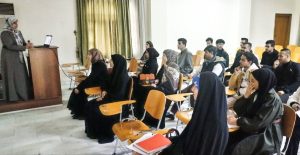
The College of Science at the University of Kerbala discussed a PhD dissertation by Nora Jameel Hantaw, faculty member in the Department of Biology specializing in Physics, which 1focused on enhancing the coatings of dental implants prepared using the flame spraying technique.
The study applied biocompatible coatings onto metallic substrates of titanium alloy (Ti6Al4V) and stainless steel (316L) using flame spraying. Coatings consisted of calcium phosphate (CaP) alone or as a composite with added silver (Ag) and magnesium (Mg), aiming to produce implants capable of improving bone adhesion and preventing bacterial colonization.
The researcher employed several characterization techniques including X-ray diffraction (XRD), field-emission scanning electron microscopy (FESEM), energy-dispersive X-ray spectroscopy (EDX), and Fourier-transform infrared spectroscopy (FTIR), in addition to adhesion testing (ASTM D3359) and contact angle measurements to evaluate wettability.
Antibacterial activity was assessed against Streptococcus mutans using the inhibition zone method, alongside evaluations of biocompatibility and ion release behavior after immersion for one month in simulated body fluid (SBF).
The findings revealed that the prepared coatings exhibited high biocompatibility, as indicated by the formation of a hydroxyapatite layer after immersion, along with uniform nanoscale porosity and hydrophilic properties. The composite (CaP + Ag + Mg) demonstrated superior performance in terms of bioactivity and antibacterial inhibition, particularly on titanium substrates, with chemical stability and no detectable toxicity within permissible biological limits.
The dissertation recommended conducting in vivo experiments on animal models (such as rabbits) to assess tissue response, osseointegration, and long-term toxicity, as well as investigating the effect of extended immersion times in simulated body fluid on apatite-like layer formation. Such efforts could contribute to the development of more effective coatings for medical implants.