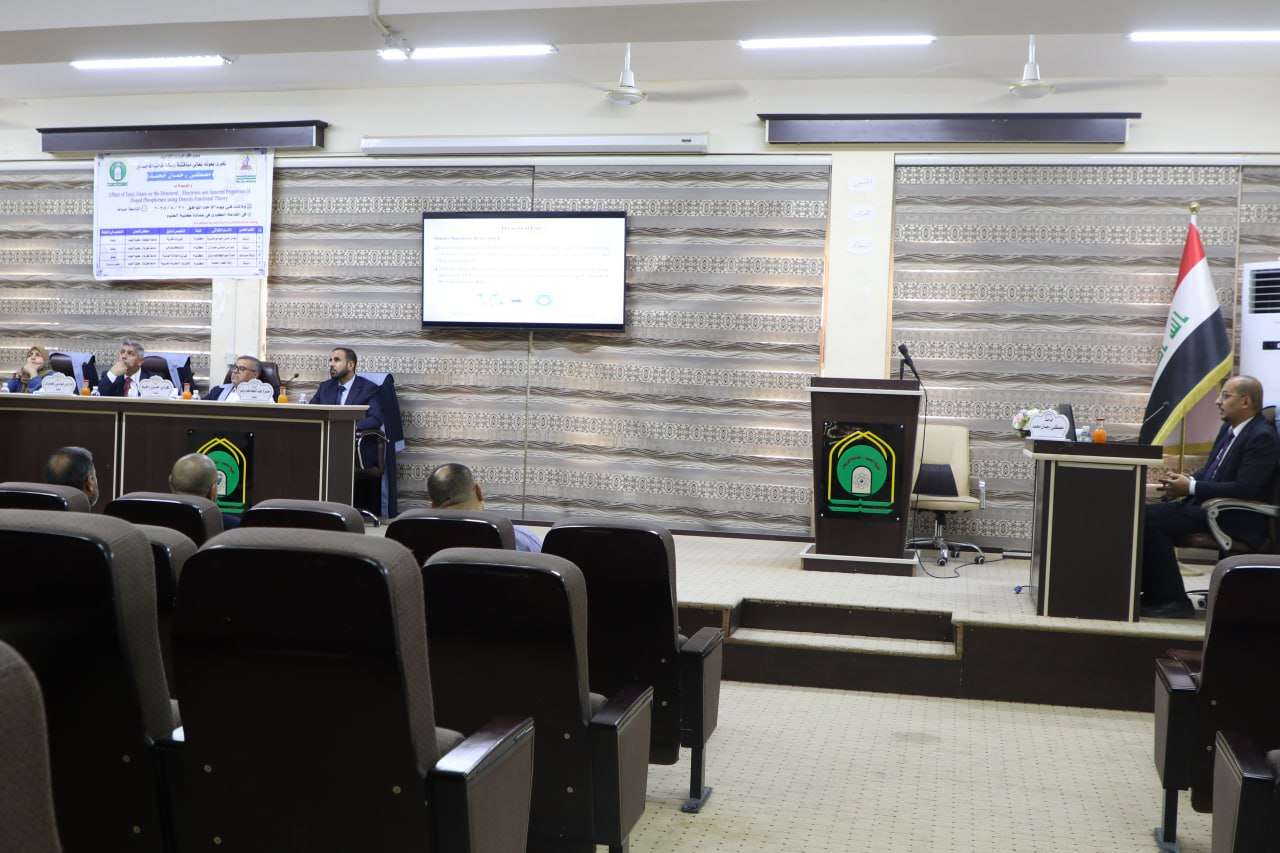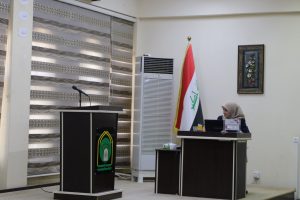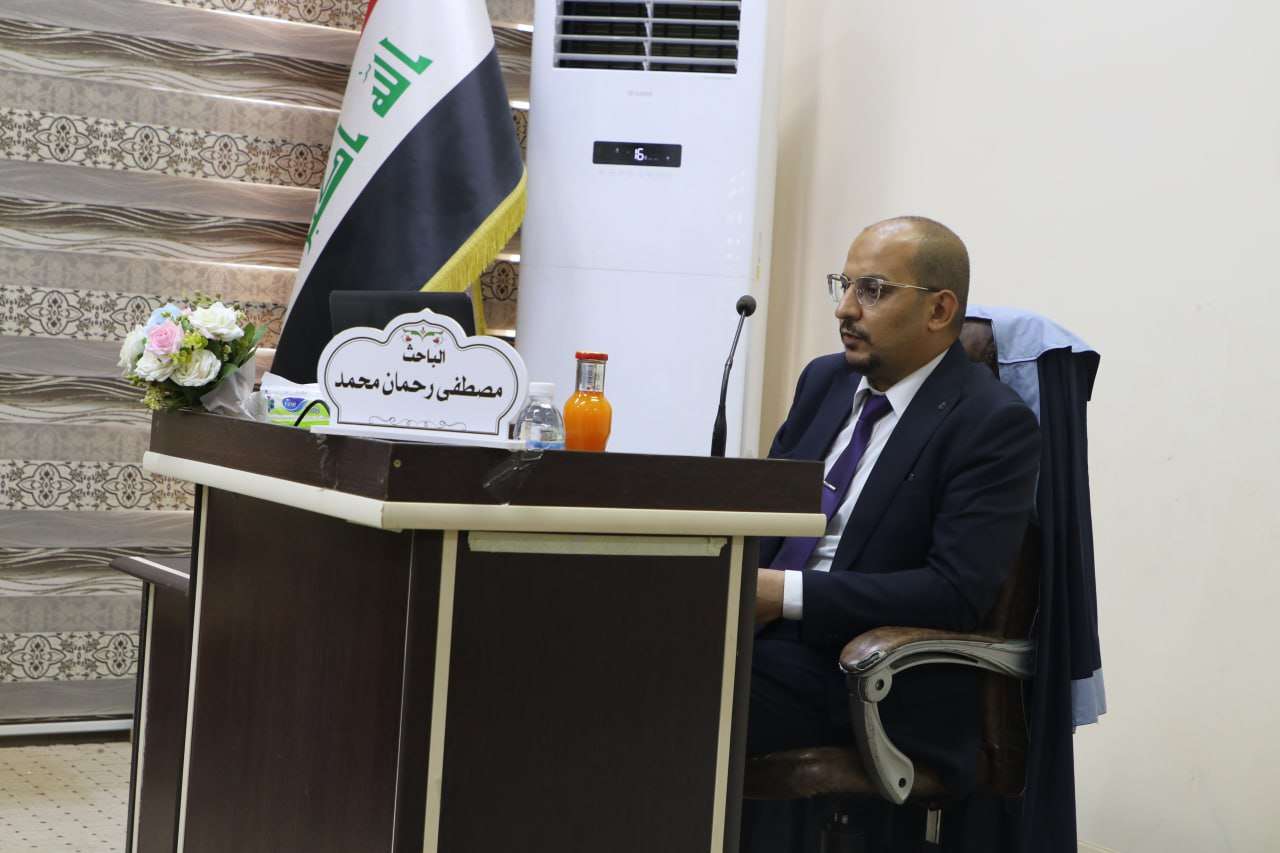
The College of Science at the University of Kerbala discussed a master’s thesis by Mustafa Rahman Mohammed from the Department of Physics, focusing on the effect of toxic gases (CO, H₂S, NO) on the structural, electronic, and spectral properties of boron- and aluminum-doped monolayer phosphorene using Density Functional Theory (DFT).
The thesis aimed to evaluate adsorption energy and sensitivity of BP₁₅ and AlP₁₅ compounds toward toxic gases, by studying geometric structure, energy gap, bond lengths and angles, electron affinity, ionization energy, and spectral analysis with the B3LYP hybrid functional and 6-31G basis set, to explore their potential in designing high-performance gas sensors.
Results showed that BP₁₅ is a highly efficient sensor for NO gas with a sensitivity of 162% and a good sensor for H₂S with 79%, while AlP₁₅ exhibited moderate sensitivity toward NO with 40%. Calculations revealed that adsorption in BP₁₅ sensors was strong chemisorption, whereas in NO\AlP₁₅ it was physisorption. Moreover, UV-Vis spectra indicated a redshift toward the near- and mid-infrared regions at wavelengths between 3200–9400 nm.
The study concluded that doping phosphorene with elements such as boron and aluminum significantly modifies its crystalline structure and electronic properties, making it a promising material for high-efficiency gas sensor design.
The thesis recommended BP₁₅ as an effective candidate for toxic gas detection, especially NO and H₂S, and suggested expanding future research to include other dopants for developing advanced nanomaterials with enhanced sensing performance.